

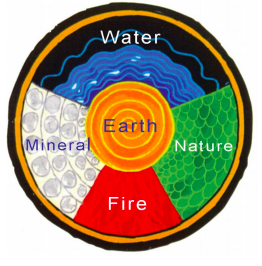
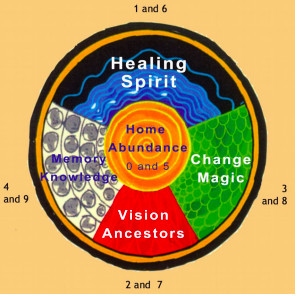
EMBODYING THE FIVE ELEMENTS
People and cultures embody one or several of the five elements knowingly or not. The most commonly seen elements at the level of cultures are fire and water. Indigenous cultures identify with water. They are mostly peace and harmony seekers. On the contrary, modern cultures identify with fire. They challenge everything and everyone at the great risk of cosmic disruption.
Within these cultures, individuals are born embodying one of these elements as their essence and carrying the rest at a variety of levels as support elements. No one can be just one element without the presence of the other four. Your essence is your genius. Your destiny is to allow your genius to come out wrapped in the colors of your character. A person with vision and passion who is always active and involved in countless activities embodies fire. A person with a deep focus who tends to seek peaceful solutions to conflicts, who always sees harmony instead of discord, embodies water. A person who tends to take care of others, accepting them as they are, embodies earth. A person with great social skills, who is always drawn to connect with others and who holds the stories of others, embodies mineral. Finally, a person who can’t stand phoniness, who finds it impossible to pretend, who can only be himself or herself, embodies nature.
YOUR ELEMENT
Your elemental tribe in the Dagara Culture is determined by the last digit of your birth year. Because the last digit of your birth year is 2, you are part of the Fire Tribe. Here is what that means:
FIRE
Fire is the original element of origin, the one that was present at the beginning. Its primal nature is combustion, warmth, vision, and feeling. Its position in the wheel is the south, the underworld, and its color is red. It is the state to which everything eventually returns, the state the ancestors are in. As we walk the earth, we are warmed by the heat of the ancestors coming from the underworld below us. Fire opens the doorway to the Spirit world and allows our psyche to commune with other life processes, past, and future. Fire is like a connecting rod, an open channel. In fact, fire is our psyche, the spirit part of us that knows what has always been. It is our ability to act, emote, and intuit. A person on fire is craving action. In this person, fire is translated into restlessness, a great deal of emotion, and strong dream experience.
The fire person is someone with an eye to the world of the ancestors and the spirit. He or she is in charge of the gateway between this world and the other, the ancestral. This person understands dream imagery and can translate and interpret dream images to people. The fire person lives at the edge between human culture and ancestral culture. His or her task is to go back and forth between the two worlds. There is a unique aspect to such a person due to this ability to see into both worlds. Shamans fit this category because they live in two worlds. They are not part of the common people, who fit well into their culture. They can see the world of their culture from the perspective of the world of the spirit. Similarly, people who feel at the margins of their culture may be dealing with the fire of their culture. They cannot quite fit in, and other people have problems understanding why they won’t behave like everybody else.
The fire person is often misunderstood by contemporaries because, with respect to this world, a fire person lives in the future and therefore finds the average person too slow. His or her behavior can be seen by the average person as impatient, hyperactive, and sometimes intolerant. A fire person cannot stay idle. However, his or her fire may be translated into a warm, gentle flame that keeps a whole village, community, town, or culture aware of its vital relationship with other worlds.
If a person or culture forgets its crucial relationship with other worlds, that is, with the ancestors, a fire is ignited that becomes a destructive force in society. When that happens, a person or a culture suddenly perceives almost everything in terms of fire. Fire becomes equated with power, speed, hierarchy, and value. All this is symptomatic of a culture in combustion. When one’s culture is burning, it is impossible to sit still and keep focused. Like a ball of fire moving at high speed, a culture on fire is fascinated with speed.
This speed shows up as horsepower on the surface, but deep within it is orchestrated by combustion. The burning within is symptomatic of some kind of crisis that drives people to remain endlessly “on fire.”
The following description of a fiery culture may seem negative and unattractive. However, it is necessary to balance the positive elements of the fire person as an individual with the negative picture of a culture on fire. The reality is that fire is dangerous; when it runs out of control, it destroys everything in its path.
When a culture is caught in fire, its people’s perception of the world is altered. As they rush ceaselessly forward with a consumer’s mentality, they pollute everything in their way, conquering and destroying anything that interferes. Fire culture promotes consumerism and cultivates scarcity in order to increase restlessness, then uses the restless, burning psyche as energy to increase production and consumption. Meanwhile the culture on fire is fascinated by violence. As a matter of fact, violence proves to be highly marketable and stimulates the fiery nature of the culture as a whole. Consequently, a fire culture is a war culture. It sees solutions in terms of fire and conflicts as fire that can be resolved with more fire. Such a culture will require a lot of water to heal.
Excerpt from The Wisdom of Africa by Malidoma Patrice Some pp. 169 - 171.